Physical Activity Guidelines
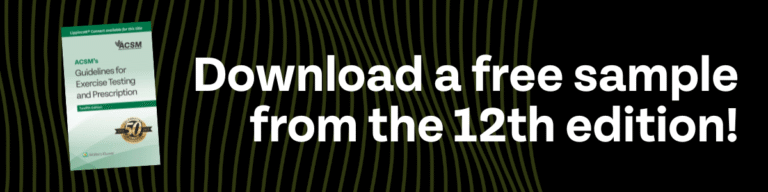
Download a free sample of the 12th edition! With a cover image of ACSM's Guideliunes for Exercise testing and Prescription, 12th edition

Research shows that regular physical activity offers numerous health benefits including, but not limited to, the regulation of blood pressure, management of anxiety and depression and the prevention of weight gain. ACSM provides recommendations and guidelines for physical activity and exercise based on the latest science and insights from health professionals.

ACSM is known throughout the industry as the “gold standard” when it comes to exercise recommendations. Thanks in large part to the publication of ACSM’s Guidelines for Exercise Testing and Prescription, now in its 11th edition. GETP has been a staple resource for professionals since 1975.

The Physical Activity Guidelines for Americans, 2nd edition, published by the U.S. Department of Health and Human Services, gives the most current physical activity recommendations for all age groups and special populations.

Divider line green, blue, black

ACSM and CDC recommendations state that: All healthy adults aged 18–65 years should participate in moderate intensity aerobic physical activity for a minimum of 30 minutes on five days per week, or vigorous intensity aerobic activity for a minimum of 20 minutes on three days per week. Every adult should perform  activities that maintain or increase muscular strength and endurance for a minimum of two days per week.
ACSM and CDC recommendations state:
  • All healthy adults aged 18–65 years should participate in moderate intensity aerobic physical activity for a minimum of 30 minutes on five days per week, or vigorous intensity aerobic activity for a minimum of 20 minutes on three days per week.
  • Every adult should perform  activities that maintain or increase muscular strength and endurance for a minimum of two days per week.
Physical Activity Guidelines
ACSM and Parkinson's Foundation announce updated exercise recommendations for safe and effective workouts for those
Explore the economic cost of physical inactivity and discover how regular activity reduces healthcare expenses
Discover essential tips on prescribing exercise for older adults to optimize brain function and promote

ACSM is pleased to present the scientific reviews underlying the second edition of the Physical Activity Guidelines. Health professionals, scientists, community organizations and policymakers can use the papers included in the ACSM Scientific Pronouncements: Physical Activity Guidelines for Americans, 2nd Edition to promote more active, healthier lifestyles for individuals and communities.

All papers were published in Medicine & Science in Sports & Exercise®.

Continuing Education

GSSI Pre-Conference

The Physiology of Hydration: More Than Water Alone

This session explores the physiology of hydration through an integrated lens—examining how carbohydrate, sodium, flavor, and fluid interact to influence intake, absorption, retention, and performance. We’ll review current research on fluid balance, osmotic drivers, and palatability, highlighting mechanisms that underpin voluntary intake and thermoregulation. Attendees will gain insight into individualized strategies, including sweat profiling and timing approaches, to optimize euhydration and mitigate performance decrements associated with >2% body-mass loss. Practical applications will be linked to laboratory- and field-based research, ensuring translation from bench to field. This pre-conference equips you with evidence-based tools to support athlete hydration across diverse environments and sporting contexts. 

Divider line green, blue, black
  • Session 1: Sweating the detail: New insights on hydration considerations for athlete performance
    • Lewis James, PhD, Associate Professor in Human Nutrition in the School of Sport, Exercise and Health Sciences at Loughborough University
  • Session 2: Functional ingredients in fluid replacement beverages for athletes
    • Lindsay Baker, PhD, Director at the Gatorade Sports Science Institute
  • Session 3: The hydration toolkit: Practical approaches to athlete support
    • Floris Wardenaar, PhD, Associate Professor at the College of Health Solutions at Arizona State University