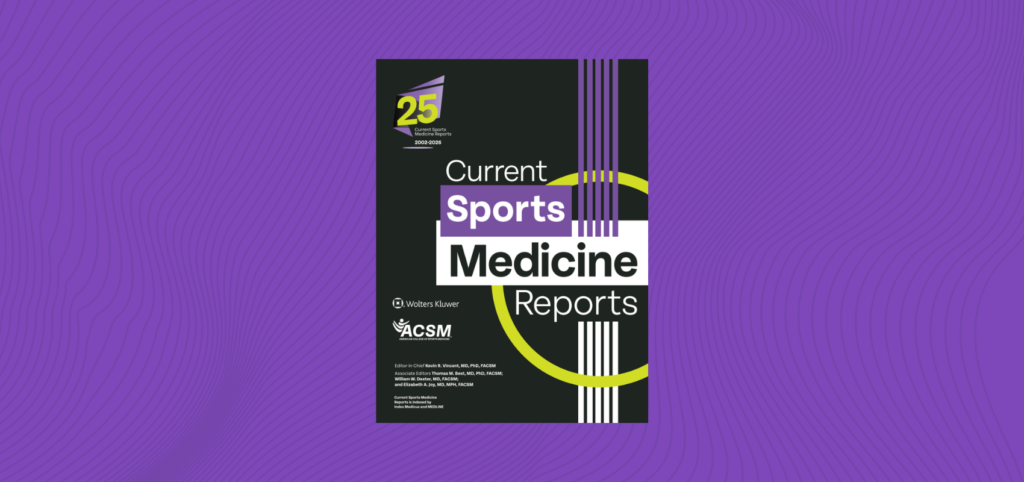
Current Sports Medicine Reports

Accurate, unbiased and practical information on health and fitness.

Current Sports Medicine Reports (CSMR), is a monthly journal for clinicians that responds to your unique information needs by addressing one sports medicine topic in-depth in each issue. This is one of the most thorough reviews of current sports medicine literature you’ll find out there.

ISSN: 1537-8918

Journal Impact Factor: 1.4

CSMR provides peer-reviewed case reports and section articles in the following topical areas:

  • Head, Neck and Spine Conditions
  • General Medical Conditions
  • Abdominal and Chest Conditions
  • Environmental Conditions
  • Sideline and Event Management
  • Training, Prevention and Rehabilitation
  • Exercise is Medicine
  • Nutrition and Ergogenic aids
  • Extremity and Joint Conditions
  • Sport-specific Illness and Injury
  • Competitive Athletes
  • Special Populations

From the Editor

Kevin R. Vincent, MD, PhD, FACSM
CSMR Editor-in-Chief​​

Dear Readers,

Welcome to the November 2026 issue of Current Sports Medicine Reports, focused on competitive sports. We are pleased to present a timely collection of articles that address the evolving clinical and safety challenges encountered across modern athletics. My sincere gratitude goes to Section Editor Mark Riederer, MD, FACSM, for curating an outstanding lineup that equips clinicians with actionable strategies to safeguard and optimize performance in active populations.

We open this issue with a Pearls and Pitfalls contribution from E. Randy Eichner, MD, FACSM, examining the urgent issue of accelerating heat risks in sport. This piece emphasizes that proactive, evidence-based heat acclimatization and monitoring protocols must be integrated into athletic settings before environmental conditions reach critical thresholds. Coleman Strosahl, MD, also provides this month’s Web Alert, highlighting valuable digital tools to keep clinicians updated on emerging sports medicine literature.

Our section articles feature clinical insights across a spectrum of sports and pathologies:

  • Youth Hockey Injury Patterns: Devan Sheffield, DO and Mark F. Riederer, MD, FACSM, review injury profiles and prevention techniques amid the sport’s rapid expansion. For sports medicine providers, understanding these acute and overuse injury trends aids in implementing targeted equipment guidelines and body-checking education to prevent long-term joint and head trauma in young athletes.
  • Lower Extremity Neuropathies: Derek C. Stokes, MD and Daniel M. Cushman, MD, outline practical diagnostic and management considerations for nerve entrapments and neuropathies in athletes. Early identification of peripheral nerve dysfunction allows clinicians to distinguish neurogenic symptoms from primary musculoskeletal strain, guiding targeted conservative management and avoiding unnecessary procedures or delayed return to play.
  • Boxing Medicine Beyond the Ringside: Alex Houser, DO, et al. explore comprehensive medical care for combat athletes outside the immediate competition window. This work broadens the clinician’s role to encompass systemic health monitoring, chronic traumatic brain injury mitigation, and tailored post-bout recovery protocols essential for long-term athlete safety.
  • PRP for Partial UCL Tears: Adam Fogel, BS, et al. examine the therapeutic evidence surrounding platelet-rich plasma injections for partial ulnar collateral ligament injuries of the elbow. This review helps sports medicine specialists evaluate non-surgical biologic options, optimizing conservative treatment algorithms for overhead athletes seeking joint preservation and accelerated return to competition.
  • Pickleball Injuries in Adults: Davis Witt, MD, et al. present a narrative review on injury trends in pickleball as participation surges nationwide. Recognized clinical patterns empower providers to anticipate kinetic chain overuses and acute lower-extremity or upper-extremity injuries in recreationally competitive and aging athletes, facilitating proactive rehabilitation and injury prevention education.


Together, these articles provide practical, evidence-informed guidance designed to refine clinical decision-making, enhance injury prevention strategies, and elevate the quality of care provided to active individuals at every competitive level.

Thank you for your continued dedication to sports medicine and for reading Current Sports Medicine Reports.

Sincerely,

Kevin R. Vincent, MD, PhD, FACSM
Editor-in-Chief
Current Sports Medicine Reports

Featured Articles

Recommended Resources
Clinical Highlights from Current Sports Medicine Reports | Q2 2026
Dr. Vincent highlights the latest clinical research published in Current Sports Medicine Reports.
Air Pollution Is Hurting Athletic Performance and Health—ACSM Honors Top Paper Offering Practical Solutions
Air pollution exposure is linked to decreased endurance, impaired lung function & cognitive effects that
Clinical Highlights from Current Sports Medicine Reports | Q1 2026
Dr. Vincent highlights the latest clinical research published in Current Sports Medicine Reports.
Current Sports Medicine Reports journal cover 2026
Current Sports Medicine Reports: A 25 Year Anniversary Historical Perspective
Explore the rich CSMR history, from its launch in 2002 to its evolution as a
Clinical Highlights from Current Sports Medicine Reports | Q4 2025
CSMR editor-in-Chief Dr. Shawn Kane highlights selected articles published in Current Sports Medicine Reports during
Cover of Current Sports Medicine Reports (CSMR)
ACSM Names Incoming Editor-in-Chief of Current Sports Medicine Reports

Kevin R. Vincent, PhD, MD, FACSM, CAQSM, has been selected as the next editor-in-chief of

Read More

Paper of the Year

View the current and previous Paper of the Year selections and editorials covering the selected articles.

GSSI Pre-Conference

The Physiology of Hydration: More Than Water Alone

This session explores the physiology of hydration through an integrated lens—examining how carbohydrate, sodium, flavor, and fluid interact to influence intake, absorption, retention, and performance. We’ll review current research on fluid balance, osmotic drivers, and palatability, highlighting mechanisms that underpin voluntary intake and thermoregulation. Attendees will gain insight into individualized strategies, including sweat profiling and timing approaches, to optimize euhydration and mitigate performance decrements associated with >2% body-mass loss. Practical applications will be linked to laboratory- and field-based research, ensuring translation from bench to field. This pre-conference equips you with evidence-based tools to support athlete hydration across diverse environments and sporting contexts. 

Divider line green, blue, black
  • Session 1: Sweating the detail: New insights on hydration considerations for athlete performance
    • Lewis James, PhD, Associate Professor in Human Nutrition in the School of Sport, Exercise and Health Sciences at Loughborough University
  • Session 2: Functional ingredients in fluid replacement beverages for athletes
    • Lindsay Baker, PhD, Director at the Gatorade Sports Science Institute
  • Session 3: The hydration toolkit: Practical approaches to athlete support
    • Floris Wardenaar, PhD, Associate Professor at the College of Health Solutions at Arizona State University