Advancing the Science - Integrating Physical Activity into Healthcare and Communities
Exercise is Medicine® (EIM) supports the advancement of research on integrating physical activity into healthcare and community settings worldwide. This work generates evidence to inform clinical practice and policy, strengthen health systems, and improve individual and community health.
Progress requires researchers, clinicians, practitioners and partners across disciplines to collaborate, explore emerging questions, evaluate innovative approaches and translate knowledge into practice.
From Evidence to Implementation
Decades of research demonstrate the health benefits of physical activity. Yet physical activity remains underused in healthcare, is not routinely incorporated into clinical care, and too few patients are connected with opportunities to be active in their communities.
Closing this gap requires research focused not only on whether interventions work, but also on how they can be adopted, implemented, scaled, sustained and evaluated across diverse healthcare and community settings.
Advancing the Evidence Base
Integrating physical activity into healthcare and communities requires multidisciplinary research across complementary areas. Together, these areas build the evidence needed to improve practice, shape policy, strengthen health systems and advance health outcomes.
Health Service Delivery
Education & Professional Training
Clinical-Community Integration
Population Impact
Health Economics & Financing
Equity & Access

The EIM Research Learning Collaborative
Building capacity. Fostering collaboration. Advancing research.
The EIM Research Learning Collaborative (EIM RLC) is a global community of researchers, clinicians, practitioners and partners working to advance the science of physical activity integration.
By connecting diverse perspectives and expertise, the collaborative:
- Builds research capacity
- Encourages innovation and shared learning
- Fosters partnerships and collaboration
- Strengthens the evidence base
- Accelerates the translation of research into real-world practice
How the Collaborative Works
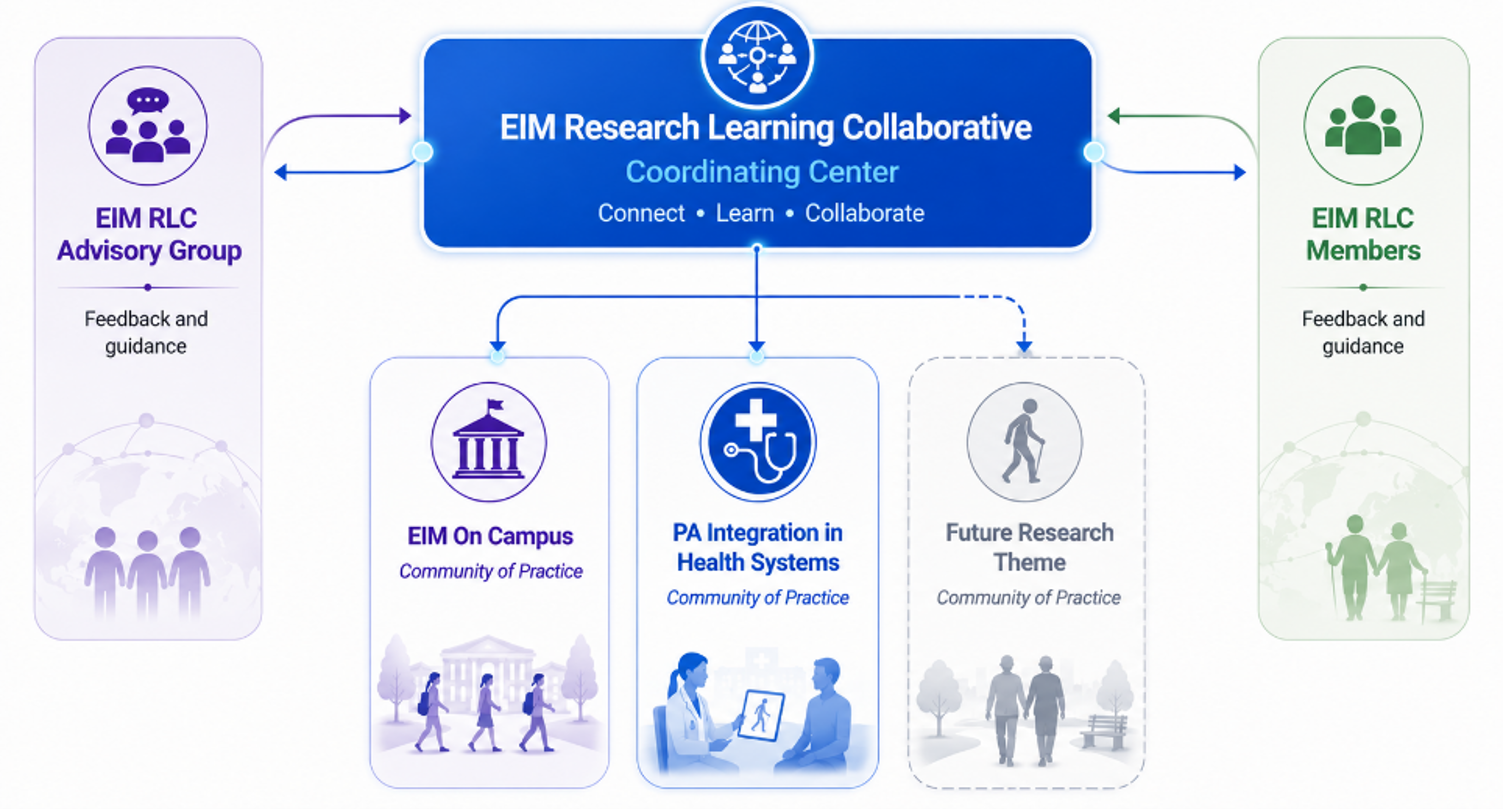
The EIM RLC gives members opportunities to exchange knowledge and resources, build relationships, generate new ideas and collaborate on research addressing real-world implementation challenges.
The EIM RLC Coordinating Center supports this community through activities that highlight emerging research, facilitate shared learning and identify opportunities for collaboration across disciplines and settings.
Members can also participate in research themes—communities of practice organized around shared areas of interest. Within each theme, members explore common challenges, exchange ideas and resources, and develop potential collaborations. Additional themes will be introduced as new priorities and member interests emerge.
Join our global community of researchers, practitioners, and clinicians working together to advance the science of integrating PA into healthcare and community settings. Whether you are looking to collaborate, share ideas, build capacity, or contribute to new research, we invite you to become part of the EIM Research Learning Collaborative.
Support for the Exercise is Medicine® Initiative is provided by: