
New evidence review of data from 30,000+ participants finds the biggest benefits come from consistency, not complicated programs
The American College of Sports Medicine (ACSM) has published a new Position Stand summarizing resistance training recommendations for healthy adults — the first major update since 2009.
The Position Stand synthesized findings from 137 systematic reviews representing more than 30,000 participants, offering the most comprehensive evidence-based guidance to date on how resistance training supports muscle strength, muscle size (hypertrophy), power, and physical performance across adulthood.
The Clear Message: Consistency Beats Complexity
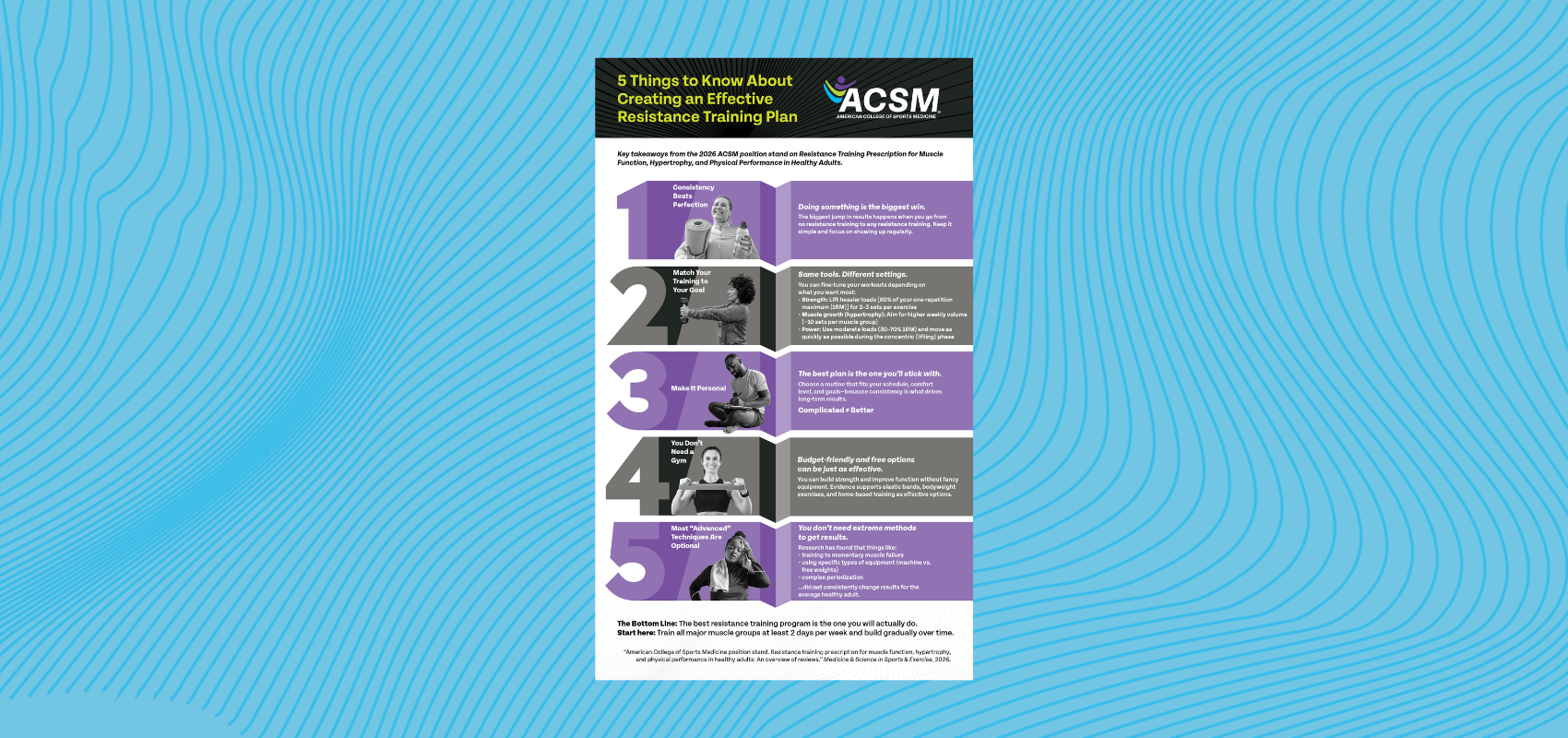
The Position Stand emphasized that the most meaningful gains come from a simple shift: moving from no resistance training to any form of resistance training. While specific training variables can be tweaked, the primary goal for most adults should be regular participation in any form of resistance training.
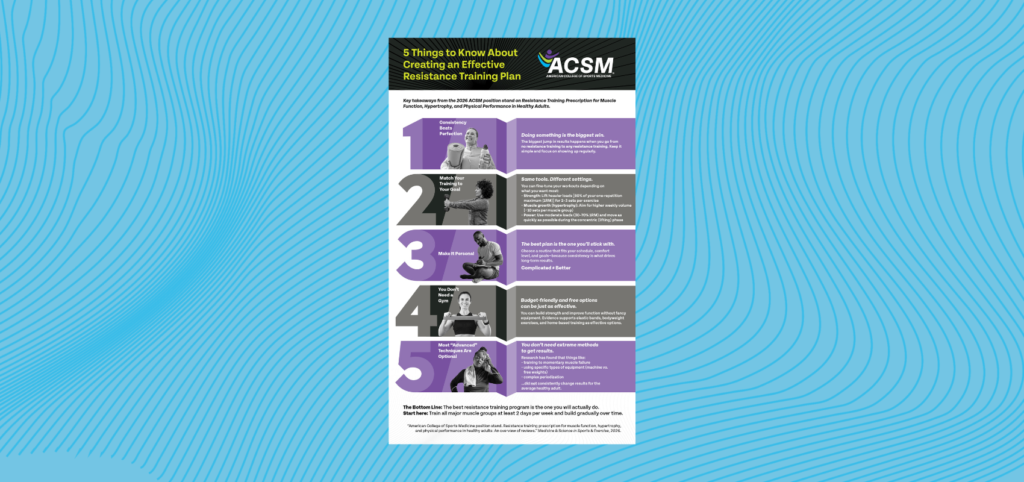
“The best resistance training program is the one you’ll actually stick with,” said Stuart M. Phillips, PhD, FACSM, an author on the Position Stand and Professor in the Department of Kinesiology at McMaster University. “Training all major muscle groups at least twice a week matters far more than chasing the idea of a ‘perfect’ or complex training plan. Whether it’s barbells, bands, or bodyweight, consistency and effort drive results.”
Further Takeaways: Individualization Matters More Than Rigid Rules
- Move away from “one-size-fits-all” prescriptions. Programs should be individualized based on personal goals, enjoyment, and safety to maximize long-term adherence. If a program is too demanding to maintain, it loses its effectiveness. Athletes and avid resistance trainees would, of course, require specific training plans to emphasize their sport and training goals.
- Load and volume should be tailored to individual goals. While many styles of resistance training generate results, outcomes can be optimized by adjusting the approach.
- For Strength: Lift heavier loads [80% of one-repetition maximum (1RM)] for 2–3 sets per exercise.
- For Muscle Growth (Hypertrophy): Aim for higher weekly volume (~10 sets per muscle group).
- For Power: Use moderate loads (30–70% 1RM) and emphasize moving the weight as quickly as possible during the concentric (lifting) phase.
- Nontraditional training is highly effective. Traditional gym settings are not needed to see results. Utilizing tools such as elastic bands, bodyweight exercises, and home-based routines yield marked benefits in strength, hypertrophy, and physical function.
- Advanced techniques are often optional. Many popular training concepts are not strictly necessary for general health and fitness. The data review found that training to fatigue or momentary muscle failure, using specific types of equipment (machines vs. free weights), and complex periodization (systematic variation) did not consistently impact outcomes for the average healthy adult.
The full ACSM Position Stand, “Resistance Training Prescription for Muscle Function, Hypertrophy, and Physical Performance in Healthy Adults: An Overview of Reviews,” is available now in Medicine & Science in Sports & Exercise®.
View and download a complementary infographic.
###
About the American College of Sports Medicine
The American College of Sports Medicine (ACSM) is the largest sports medicine and exercise science organization in the world, with nearly 50,000 members and certified professionals in more than 100 countries. Together, ACSM is committed to the mission of educating and empowering professionals to advance the science and practice of health and human performance. ACSM advocates for legislation to help the government and health community make physical activity a priority. Visit acsm.org to learn more.