
Meeting the 50th Percentile for 24-hour Movement Helps Cognitive Function
Alzheimer’s disease and related dementias are debilitating conditions leading to impaired cognitive processes and worsening physical functioning. They place significant burden on caregivers and health care systems. Roughly 15 million cases of cognitive impairment and Alzheimer’s disease in the U.S. are projected by 2060. While there are no medical treatments to delay Alzheimer’s disease progression, […]
Computational Neuroscience Approaches to Exercise Behaviors in Older Adults
Engagement in physical exercise has shown widespread benefits on cardiovascular, physical, emotional and cognitive health in older adults. However, initiating and sustaining an exercise routine over the long term (e.g., six months or more) is incredibly challenging. Our historical understanding of the factors that determine engagement in physical exercise comes from psychological and psychosocial theories, […]
Cardiac Adaptation to Endurance and Resistance Training

In our Studies of Twin Responses to Understand Exercise THerapy (STRUETH) trial, we recruited monozygotic and dizygotic twin pairs and supervised them through three months of endurance training and three months of resistance exercise training. Each twin pair exercised together, at matched exercise prescriptions, and all subjects undertook both forms of exercise. We measured many […]
Breathing Your Way toward Mental Clarity
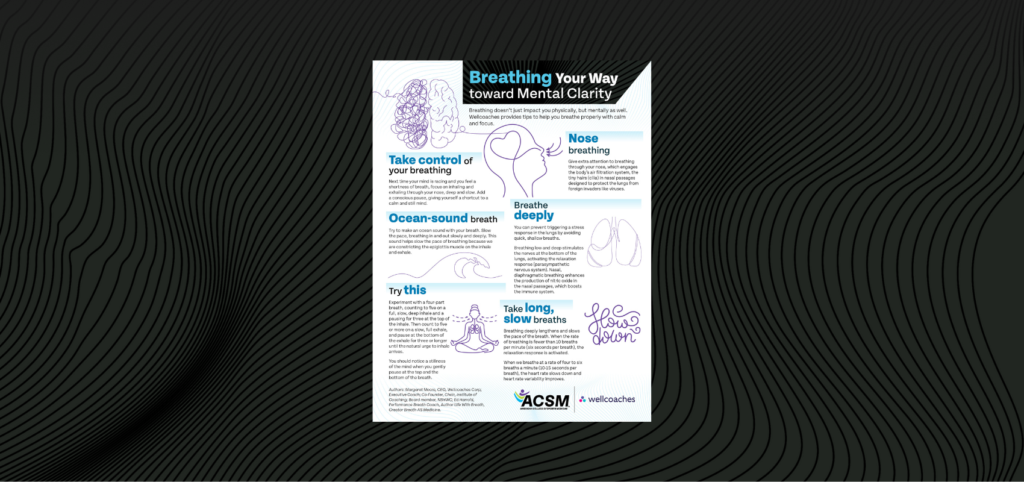
Breathing doesn’t just impact you physically, but mentally as well. This infographic shares breathing exercises to help you or your clients control breathing as a way to improve mental health.
Learning from Experience: Growth Potential of Exercise from Free-Living Protein Synthesis in Men and Women

Skeletal muscle is the engine that drives human health and performance and is influenced by modifiable healthy lifestyle behaviors (i.e., nutrition and exercise) and non-modifiable factors (i.e., sex and age). It is well-established that resistance exercise stimulates the synthesis of skeletal muscle protein (especially the force-generating myofibrillar fraction) for up to 48 hours. This ultimately […]
Cognitive Benefits of Physical Activity for Older Adults
Physical activity improves both physical and cognitive health, especially among older adults. Cognitive health encompasses many aspects of our daily functioning: memory, maintaining attention and concentration, dealing with distractions, solving problem and making decisions. Those cognitive functions tend to decline as we age, and physical activity can greatly prevent cognitive decline. For example, a meta-analysis has shown […]
Mental Health Awareness and the Role of Exercise Professionals

May is Mental Health Awareness month, which the American Heart Association calls “a time to raise awareness of those living with mental or behavioral health issues and to help reduce the stigma so many experience.” We might increase awareness by letting people know about the National Suicide Prevention Lifeline, which provides around-the-clock emotional support for people in crisis. […]
Effects of Physical Activity on Mental Health in Vulnerable Populations
If you or someone you know is managing a mental illness, then you or they are not alone. Many Americans struggle with mental illnesses. Almost one in five adults live with a mental illness (52.9 million in 2020). Mental illness is defined by the National Institute of Mental Health as a mental, behavioral or emotional […]
High Intensity Physical Activity in Individuals with Elevated Levels of Coronary Artery Calcium Appears to Be Safe

The 2018 Physical Activity Guidelines for Americans notes that there is no obvious “best amount” of physical activity and no evidence of increased risk, even among those that engage in high intensity activities. However, vigorous physical activity may acutely increase the risk of heart attack and sudden cardiac death in some individuals. Recent studies have shown that large […]
High-Intensity Interval Training (HIIT) Enhances Neuroplasticity in Healthy Older Adults
Neuroplasticity is the ability of the brain to physiologically change due to our experiences. There is accumulating evidence for the benefits of a single session of aerobic exercise to enhance motor learning and neuroplasticity in young adults. Stationary cycling exercise performed immediately before or after skilled motor practice enhances motor learning that involves movements of […]