In February 2002, the landscape of sports medicine literature changed with the launch of Current Sports Medicine Reports (CSMR). Founded on the principle that the field is an “inclusive umbrella” spanning across disciplines, the journal has evolved from a niche bimonthly publication into a premier monthly resource that serves as the clinical heartbeat of the American College of Sports Medicine (ACSM).
The following historical perspective outlines the journal’s trajectory from its inception to its current role as a vital tool for evidence-based patient care.
The Vision of Inclusivity (2002–2009)
At its founding, Robert Sallis, MD, FACSM, set a clear mandate for CSMR: to bridge the gap between complex scientific research and the practical needs of the clinician. Dr. Sallis viewed sports medicine as anything that affects a person’s ability to participate in physical activity; a philosophy that mirrored ACSM’s mission to enhance quality of life through movement.
Under Dr. Sallis’ leadership, CSMR established itself as a “translator” for the field. While other journals focused on bench research, CSMR focused on application, ensuring that physicians, athletic trainers, and physical therapists had a reliable roadmap for treating the “active patient.” His tenure saw a pivotal transition in November 2007 when ACSM and Lippincott Williams & Wilkins acquired the journal, fully integrating it into the ACSM family of publications.
Institutional Growth and Digital Evolution (2010–2017)
The second chapter of the journal’s history was marked by institutional stability and a shift toward modern delivery. William O. Roberts, MD, MS, FACSM, took the helm in 2010.
As the medical world moved toward digital-first consumption, CSMR followed suit. In January 2015, the journal made the bold move to electronic-only (e-only) publication, a shift that allowed for faster dissemination of information and reflected the evolving habits of busy clinicians.
Expanding Impact and Modern Relevance (2018–2025)
The journal’s most significant expansion occurred under Shawn F. Kane, MD, FACSM. Recognizing the rapid pace of clinical advancement, Dr. Kane oversaw the transition from bimonthly to monthly publication in 2018. This doubled the journal’s output, allowing for more in-depth coverage of emerging topics.
Key milestones during this era included:
- The Clinical Curriculum Series (2020): Launched to provide structured, educational pathways for practitioners.
- Specialized Content: A landmark special issue on Mental Health (December 2021) highlighted the journal’s commitment to treating the “whole athlete,” addressing the psychological dimensions of sports medicine.
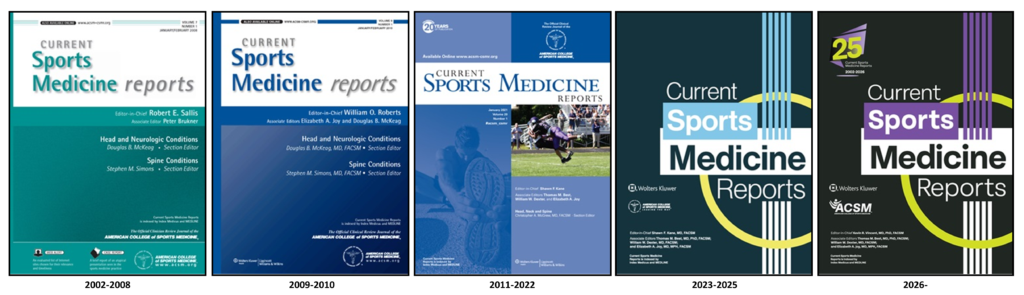
Leadership Timeline
| Editor-in-Chief | Term | Key Contributions |
| Robert E. Sallis, MD, FACSM | 2001–2009 | Founding Editor; established the journal’s clinical translation focus |
| William O. Roberts, MD, MS, FACSM | 2010–2017 | Oversaw the transition to e-only; deepened ACSM integration |
| Shawn F. Kane, MD, FACSM | 2018–2025 | Doubled frequency to monthly; launched Clinical Curriculum Series. |
| Kevin R. Vincent, MD, PhD, FACSM | 2026–present | Future-focused leader with expertise in running medicine and biomechanics |
Looking Ahead: The Next Generation
As of January 2026, Kevin R. Vincent, MD, PhD, FACSM, has assumed the role of editor-in-chief. Bringing a unique dual-background as both a scientist and a clinician, Dr. Vincent is poised to lead CSMR into an era where precision medicine and biomechanical data play larger roles in the clinic.
From a single bimonthly issue in 2002 to a powerhouse monthly e-journal today, CSMR remains true to its original goal: providing the latest clinical research in a format that does not just sit on a shelf but is applied directly to the patient on the table or the athlete on the field.

Kevin R. Vincent, MD, PhD, FACSM, is a highly respected leader in sports medicine, musculoskeletal health, and rehabilitation, bringing more than two decades of expertise to The Orthopaedic Institute (TOI). As the founder of Florida’s most established and comprehensive Running Medicine Clinic, Dr. Vincent has earned national and international recognition for his work in advancing the performance, health, and safety of runners of all ages and skill levels. His clinical interests include running medicine and sports performance, musculoskeletal health and overuse injury prevention, and strength training and biomechanics. With a passion for evidence-based care, Dr. Vincent has published extensively in the areas of sports medicine, resistance exercise, sports nutrition, and biomechanics. He is also an in-demand speaker, frequently presenting at national and international conferences on running medicine and injury prevention. Dr. Vincent has been a member of ACSM since 1992 and has served as an ACSM vice president and currently serves as the editor-in-chief of Current Sports Medicine Reports and on ACSM’s Clinical Sports Medicine Leadership Committee, ACSM’s Foundation Board, and ACSM’s Budget and Finance Committee.