Changing an entire healthcare culture takes time, vision, and, above all, bringing the right people together at the same table. For years, physical activity and medicine existed on parallel tracks. Doctors advised patients “you need to move more,” while gyms offered their services separate from the needs of the healthcare system. But this paradigm is changing.
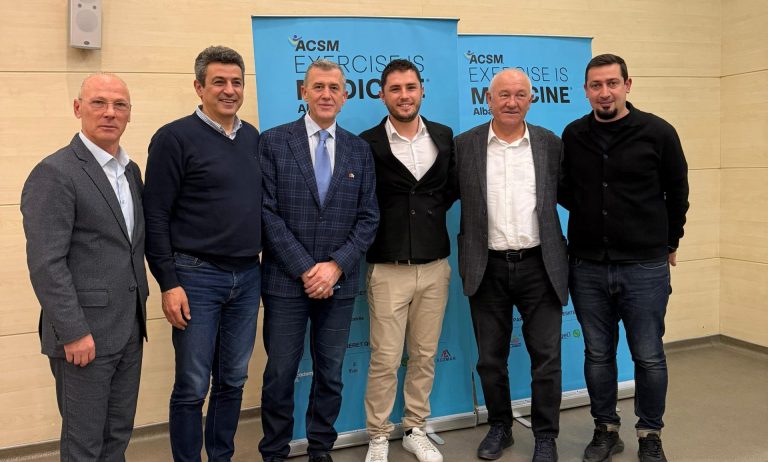
What seemed like only a dream years ago, is today turning into reality thanks to the efforts of EIM Albania. On Friday, Feb. 27, the Scientific Library of “Luigj Gurakuqi” at the University in Shkodër successfully hosted the 2nd National Conference of EIM Albania. The event was more than just another academic gathering; it was a platform for action to solve a real problem: How do we turn physical activity into a genuine medical prescription?
When medicine and academia speak the same language
The synergy created at this conference was historic. Under the dynamic leadership of Lucio Serreqi, EIM Albania Coordinator, the conference opened the doors to several long-awaited collaborations. Prof. Dr. Robert Çina, President of EIM Albania, with the support of Prof. Dr. Tonin Gjuraj, Rector (University of Shkodër), confirmed the university’s commitment to serve as the bridge between medicine and physical activity in Albania. This commitment was strengthened through the support of Prof. Assoc. Dr. Florian Miftari, Dean of the Faculty of Physical Education and Sports (University of Prishtina) and leaders from the Sports University of Tirana (UST), proving that this was truly the beginning of a national movement.
Breaking Through Silos
For the first time in Albania, this conference successfully brought together the crucial pillars of public health at the same table: the clinical sector (Regional Hospital of Shkodër), the academic/research sector (University of Shkodër, Sports University of Tirana, University of Prishtina), and health policy experts. A core achievement was moving the conversation from “exercise is a good lifestyle habit” to “exercise is a standardized clinical therapy.” We are establishing a system where doctors and kinesiologists finally speak the same medical language. Early successes include:
- Concrete Pledges & Action: The Regional Hospital pledged to integrate the “Physical Activity Vital Sign” (PAVS) directly into their triage process, meaning nurses will assess movement before the patient sees the doctor.
- International Synergy: We reached a verbal agreement with EIM Italy to enhance an ongoing collaboration through the sharing of protocols and best practices to strengthen local implementation and build a stronger, cross-border network.
- Health Gyms: The University of Shkodër pledged to transform its sports laboratories into “Health Gyms” (functional assessment and training centers for patients with chronic conditions) tailored after a model developed by EIM Italy.
The Next Steps for EIM Albania
The conference laid a strong foundation for a new partnership between medicine and physical activity in Albania, one in which institutions no longer worked separately where healthcare clinics meaningfully partnered with gyms and other exercise facilities as they became a natural extension of medical care. Shkodër is serving as an initial “pilot city” to test and perfect this referral protocol (doctor → kinesiologist → clinical feedback). With success, the next step is to scale this model to the capital city, Tirana, turning it into a national standard for the entire Albanian healthcare system.
The change is unstoppable – Exercise is Medicine!