1 min read

“With more than 43 million cancer survivors worldwide, we have a growing need to address the unique health issues facing people living with and beyond cancer and better understand how exercise may help prevent and control cancer,” said ACSM Immediate Past President Katie Schmitz, Ph.D., FACSM. 

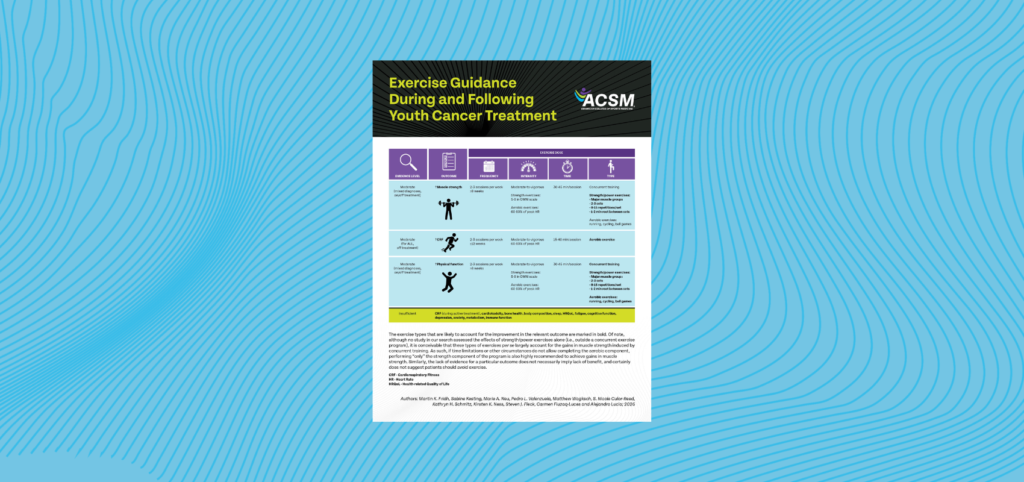
The new evidenced-based guidance and recommendations regarding exercise and cancer include:

  • For all adults, exercise is important for cancer prevention and specifically lowers risk of seven common types of cancer: colon, breast, endometrial, kidney, bladder, esophagus and stomach
  • For cancer survivors, incorporate exercise to help improve survival after a diagnosis of breast, colon and prostate cancer
  • Exercising during and after cancer treatment improves fatigue, anxiety, depression, physical function, quality of life and does not exacerbate lymphedema

Click on the image to download PDF.

Share this post

Other Related Content

Encourage your child to be active to get them started on a lifetime of health. Play and movement activities help
Inactive people who start moving get the biggest bang for their buck. Experts now say that any physical activity counts
Our golden years can be powerful years. The older you are, the more you can benefit from physical activity. Experts

GSSI Pre-Conference

The Physiology of Hydration: More Than Water Alone

This session explores the physiology of hydration through an integrated lens—examining how carbohydrate, sodium, flavor, and fluid interact to influence intake, absorption, retention, and performance. We’ll review current research on fluid balance, osmotic drivers, and palatability, highlighting mechanisms that underpin voluntary intake and thermoregulation. Attendees will gain insight into individualized strategies, including sweat profiling and timing approaches, to optimize euhydration and mitigate performance decrements associated with >2% body-mass loss. Practical applications will be linked to laboratory- and field-based research, ensuring translation from bench to field. This pre-conference equips you with evidence-based tools to support athlete hydration across diverse environments and sporting contexts. 

Divider line green, blue, black
  • Session 1: Sweating the detail: New insights on hydration considerations for athlete performance
    • Lewis James, PhD, Associate Professor in Human Nutrition in the School of Sport, Exercise and Health Sciences at Loughborough University
  • Session 2: Functional ingredients in fluid replacement beverages for athletes
    • Lindsay Baker, PhD, Director at the Gatorade Sports Science Institute
  • Session 3: The hydration toolkit: Practical approaches to athlete support
    • Floris Wardenaar, PhD, Associate Professor at the College of Health Solutions at Arizona State University