|
|
Exercise as Medicine for People with a Substance Use Disorder
1 min read

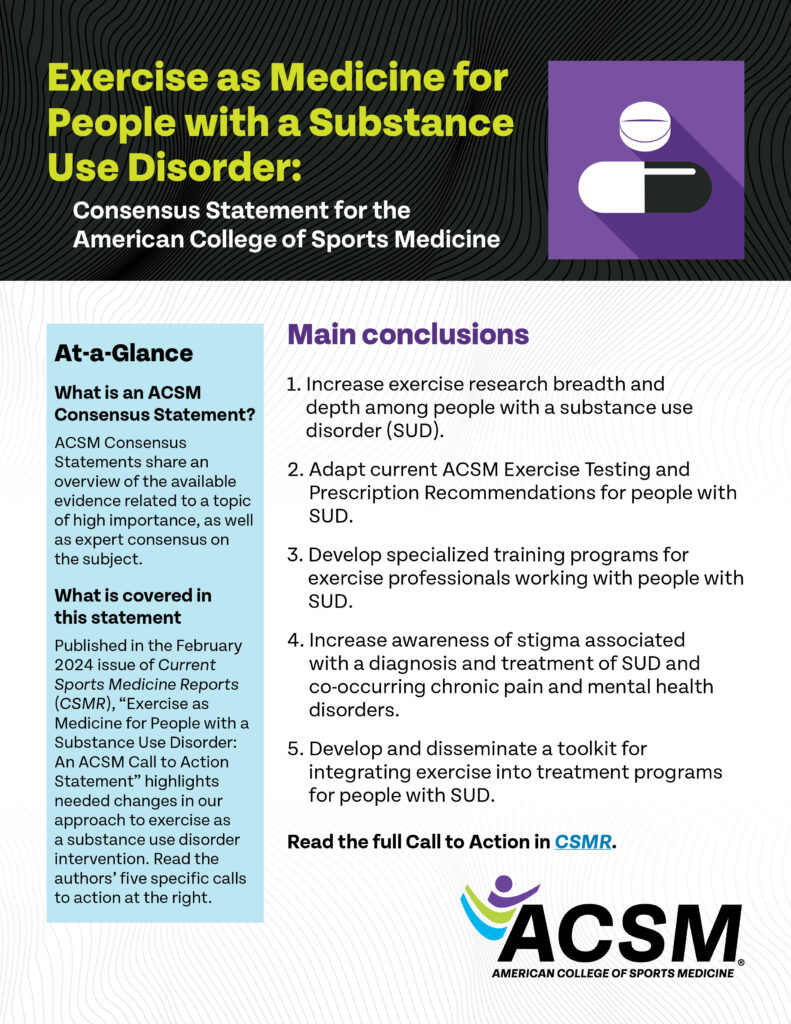
Exercise may be an effective adjunctive treatment for substance use disorders, but large clinical trials and specialized training are needed to inform practice.

A call to action statement, an official pronouncement of ACSM, has been published on this topic in Current Sports Medicine Reports.

This infographic outlines the paper’s purpose and highlights the key action items.

Click on the image to download PDF.
Share this post

Other Related Content

Air pollution exposure is linked to decreased endurance, impaired lung function & cognitive effects that can influence decision-making and athletic
Being active is a great way to improve the way your body uses insulin and burn more calories to control
If you suffer from rheumatoid arthritis (RA), an autoimmune disease that causes inflammation of the joints, being active is an

GSSI Pre-Conference

The Physiology of Hydration: More Than Water Alone

This session explores the physiology of hydration through an integrated lens—examining how carbohydrate, sodium, flavor, and fluid interact to influence intake, absorption, retention, and performance. We’ll review current research on fluid balance, osmotic drivers, and palatability, highlighting mechanisms that underpin voluntary intake and thermoregulation. Attendees will gain insight into individualized strategies, including sweat profiling and timing approaches, to optimize euhydration and mitigate performance decrements associated with >2% body-mass loss. Practical applications will be linked to laboratory- and field-based research, ensuring translation from bench to field. This pre-conference equips you with evidence-based tools to support athlete hydration across diverse environments and sporting contexts. 

Divider line green, blue, black
  • Session 1: Sweating the detail: New insights on hydration considerations for athlete performance
    • Lewis James, PhD, Associate Professor in Human Nutrition in the School of Sport, Exercise and Health Sciences at Loughborough University
  • Session 2: Functional ingredients in fluid replacement beverages for athletes
    • Lindsay Baker, PhD, Director at the Gatorade Sports Science Institute
  • Session 3: The hydration toolkit: Practical approaches to athlete support
    • Floris Wardenaar, PhD, Associate Professor at the College of Health Solutions at Arizona State University