
By 2040, most cancer survivors in the U.S. will be over the age of 65. Many will survive for five or more years, which means that they will be living with the combined threats of aging and cancer well past their initial diagnosis. Cancer and its treatments can accelerate typical aging, hastening the decline toward dependence. But exercise can be one of the most powerful tools to counteract those effects and keep older survivors aging well and in place. Unfortunately, older cancer survivors are the least likely to meet the current American College of Sports Medicine (ACSM) exercise recommendations for cancer survivors 1 than other age groups.
Although exercise could be a powerful tool for older cancer survivors, we don’t yet have enough evidence to issue specific exercise guidance that could help ease the minds of older survivors, their healthcare teams, and exercise professionals that exercise is safe and effective when delivered appropriately. In our recent systematic review2, we only found six randomized controlled trials that specifically targeted cancer survivors over the age of 65. Because of this lack of evidence, current ACSM exercise guidelines could not create evidence-based recommendations specific to older adult cancer survivors.
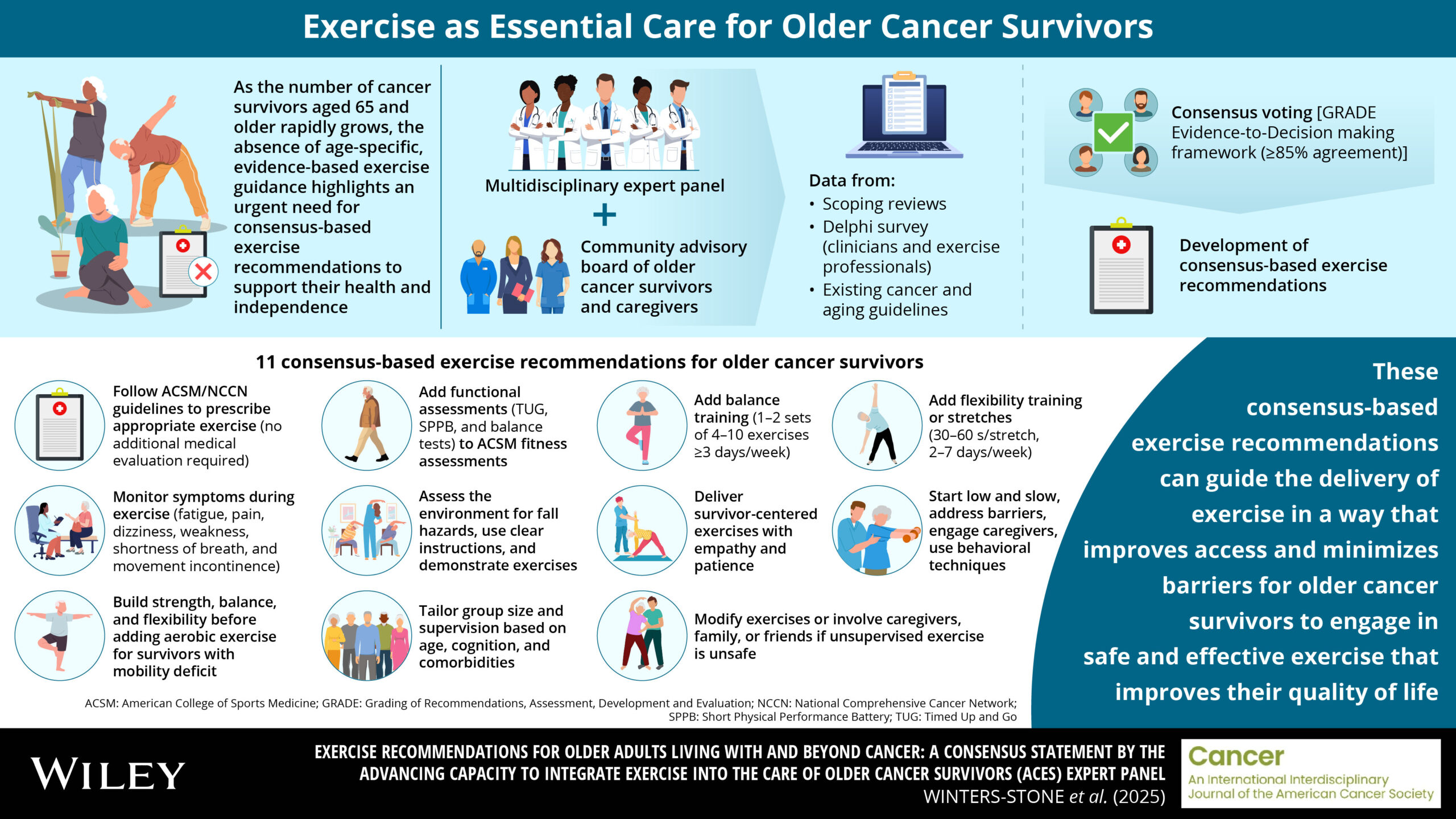
Thus, the Advancing Capacity to Integrate Exercise Into the Care of Older Cancer Survivors (ACES)3 initiative was funded by the National Cancer Institute (National Cancer Institute, Grant/Award Number: 1R21CA280996) to develop consensus-based exercise guidelines to fill a gap in the care of older cancer survivors. A multidisciplinary panel of experts developed the ACES exercise guidelines as a complement to the 2019 ACSM exercise guidelines for cancer survivors1. The panel included 14 experts in geriatric medicine, geriatric oncology, oncology nursing, exercise physiology, physical therapy, and health behavior as well as a patient advocate and exercise professional. This expert panel used input from a community advisory board of older cancer survivors and caregivers, a Delphi survey of over 250 exercise and health professionals, and a rigorous GRADE framework to guide the consensus process toward establishing a set of recommendations. Recommendations had to be deemed accessible (i.e., no added barriers) to older cancer survivors and feasible to implement. The panel reached consensus (85% or greater agreement among the panel members) on 11 recommendations, which are published3 and summarized in the infographic below:
Key points for prescribing exercise to older cancer survivors
The ACES recommendations were designed to complement (not override) the 2019 ACSM exercise guidelines for cancer survivors; hence, the 2019 ACSM guidelines apply to all older survivors first and foremost. The ACES recommendations are additive and specific to delivering exercise in older cancer survivors. We highlight a few particularly salient points below. All eleven recommendations are tailored to older adults, but four speak directly to what makes this population different: a higher risk of falls, frailty and mobility loss, and lingering barriers when knowing where to start:
- No additional medical clearance is required when considering exercise for an older cancer survivor (beyond standard ACSM 2019 guidelines). Requiring additional clearance could be a barrier to an older cancer survivor who is ready to exercise. One caveat the panel felt was important was the need to ensure vigilance and screening for unexplained changes in cognition, mobility, or function across all phases of exercise programming, which could signal a change in health status that impacts exercise safety and tolerance. A medical evaluation in these contexts should be considered.
- Balance training is recommended as part of the exercise prescription. Balance training is important for fall prevention as older cancer survivors are at greater fall risk than the general older population due to treatment-related changes in balance and strength.
- Flexibility training is also recommended as part of an exercise program for older cancer survivors. Focusing on range of motion will improve mobility in older adults and improve performance of other modes of exercise, like resistance training.
- Functional assessments are now recommended (measuring Time Up and Go (TUG), Short Physical Performance Battery (SPPB), and tests of static and dynamic balance) along with standard health and fitness assessments. Performance on functional tests can help determine the exercise prescription and benchmark progress in improving independence.
Key points for delivering exercise to older cancer survivors
Completing the ACSM-ACS Cancer Exercise Specialist Course is a strong foundation when working with cancer survivors, but older adults add layers of complexity around cognition, fall risk, and frailty which requires more attention. The panel recommended that empathy and patience be fundamental attributes that trainers should employ when working with older cancer survivors – a recommendation wholly endorsed by older survivors themselves. Delivering exercise to this population should also consider key factors like assessing the environment for risk of falls and safety, minimizing distractions in a class environment, and slowing down the pace of instruction. While the panel felt that requiring advanced certification for delivering exercise in older adults and/or cancer survivors might present a barrier for older survivors to access exercise, it is recommended that exercise professionals seek out more training, experience, and eventually certification to strengthen their skills.
Working Toward Evidence-Based Guidelines
The recommendations from the ACES initiative are an important step to increase awareness and capacity to integrate exercise into the care of older cancer survivors – helping more older cancer survivors start exercising, while ensuring safety and reducing barriers. The ACES guidelines were based on consensus in the absence of sufficient evidence – but are critical to moving the field forward in the care of older cancer survivors. There is an urgent need to build the evidence base, and the ACES panel made several recommendations about future research, much of which is currently ongoing. For example, our team is leading an effort to build capacity on best practices for the conduct of live, remote supervised resistance in older cancer survivors with physical limitations (NCT07606313; National Cancer Institute, Grant/Award Number: 4R33 CA280996-03) so that others can conduct rigorous trials to build the evidence base the panel is calling for.
As the number of older cancer survivors increases, so does the opportunity for CEPs to lead. CEPs understand how to adapt programming for unique populations and using the ACES guidelines as a resource can help add to this skill set to meet the needs of older cancer survivors – a rapidly growing population in high need. CEPs can make a meaningful, measurable difference in how older adults age with and beyond cancer.
1 Campbell, K. L., Winters-Stone, K. M., Wiskemann, J., May, A. M., Schwartz, A. L., Courneya, K. S., Zucker, D. S., Matthews, C. E., Ligibel, J. A., Gerber, L. H., Morris, G. S., Patel, A. V., Hue, T. F., Perna, F. M., & Schmitz, K. H. (2019). Exercise guidelines for cancer survivors: Consensus statement from international multidisciplinary roundtable. Medicine & Science in Sports & Exercise, 51(11), 2375–2390. https://doi.org/10.1249/MSS.0000000000002116
2 Winters-Stone, K.M., Crisafio, M., Chalmers, C., Meyers, G., Eckstrom, E., & Campbell, K. L. (2025). A scoping review of exercise oncology trials to inform best practice recommendations for exercise in older adults (65+ years) living with and beyond cancer. Journal of Geriatric Oncology, 16(7), 102334. https://doi.org/10.1016/j.jgo.2025.102334
3 Winters‐Stone, K. M., Meyers, G., Eckstrom, E., Cheville, A., Garcia, J. M., McNeely, M. L., Mohile, S., Mustian, K., Neil‐Sztramko, S., Rogers, L. Q., Schmitz, K. H., Schwartz, A., Sitemba, J., Smith, R., & Campbell, K. L. (2026). Exercise recommendations for older adults living with and beyond cancer: A consensus statement by the Advancing Capacity to Integrate Exercise Into the Care of Older Cancer Survivors expert panel. Cancer, 132(2), e70252. https://doi.org/10.1002/cncr.70252