What is Protein?
Protein is the primary structural component of the body. While it is most well-known for muscle maintenance, it is also a key component of enzymes, hormones, transporters, antibodies and many more things that are needed for proper function. Because it is involved in so many functions, inadequate protein intake causes a variety of health-related problems.
Each protein is made up of a series of smaller amino acids. These amino acids are classified as “essential” if you must eat them, and “nonessential” if your body can make them. To keep your body functioning normally, you need to eat foods with essential amino acids regularly.
Where do you get protein?
Protein comes from a wide variety of food sources, including meat, poultry, fish, legumes, tofu, eggs, nuts, seeds, dairy products, and grains. Some vegetables and fruit contain protein too, but typically in smaller amounts.
Animal-based proteins have three main advantages over plant-based proteins:
- They are generally higher in protein content.
- They are typically better absorbed in the body.
- They contain all the essential amino acids whereas most plant-based proteins lack one or more. Vegetarians can get all their essential amino acids from plants through thoughtful food selection.
How much protein should you eat?
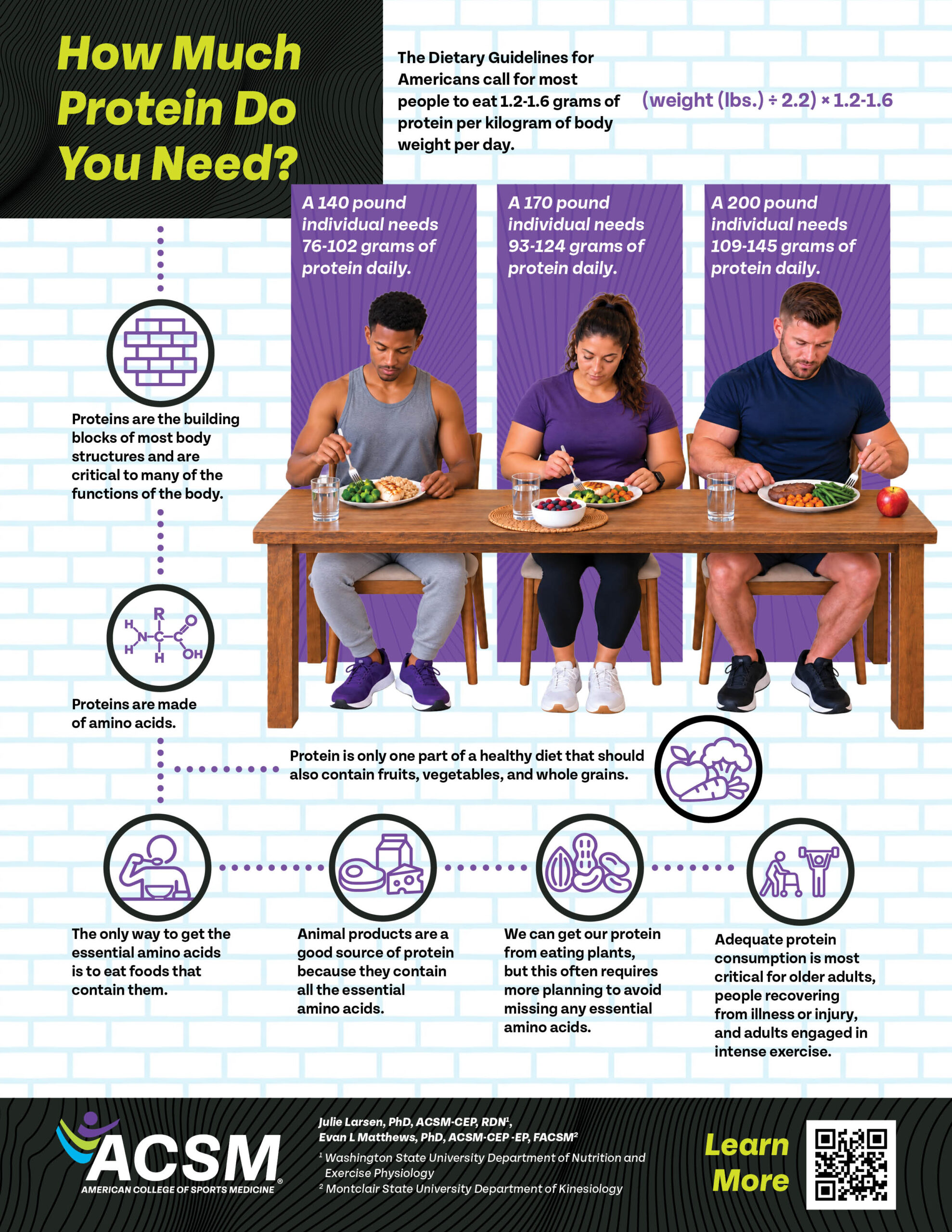
Protein intake recommendations increased in the Dietary Guidelines for Americans, 2025-2030. Most adults are now advised to eat 1.2-1.6 grams of protein per kilogram of body weight daily. This can be calculated as:
Weight in pounds ÷ 2.2 x 1.2 = Low end of recommended range
Weight in pounds ÷ 2.2 x 1.6 = High end of recommended range
For example, a 140-pound individual needs 73-102 grams of protein daily, a 170 pound individual needs 92-123 grams of protein daily, and a 200 pound individual needs 109-146 grams of protein daily.
Below is a list of good protein sources according to the Dietary Guidelines for Americans, 2025-2030.2
| FOOD SOURCE | COMMON PORTION | PROTEIN CONTENT |
| MEAT | 3 oz (cooked) | 20-27 g |
| POULTRY | 3 oz (cooked) | 20-27 g |
| SEAFOOD | 3 oz (cooked) | 18-25 g |
| YOGURT | ¾ cup | 15-20 g |
| COTTAGE CHEESE | ½ cup | 12-14 g |
| SOY | 3 oz | 8-18 g |
| MILK | 1 cup | 8-14 g |
| CHEESE | 1 oz | 6-10 g |
| BEANS, PEAS, LENTILS | ½ cup (cooked) | 6-9 g |
| EGGS | 1 large | 6 g |
| NUTS, SEEDS | 1 oz | 4-7 g |
Everyone should try to consume the recommended amount of daily protein. However, it is especially important for older adults who are more likely to experience muscle loss, for those who are healing from injuries or illnesses, and for those who are working toward aerobic or strength training goals.
What else should you know?
In addition to 3-4 daily servings of high-protein foods, the Dietary Guidelines suggest three servings of dairy, three servings of vegetables, two servings of fruit, 2-4 servings of whole grains, and four servings of healthy fats each day for the generic 2000-calorie plan.3 This can be adjusted based on individual calorie needs.
It has long been recommended that 45-65% of your calories come from carbohydrates, 10-35% of your calories come from protein, and 20-35% of your calories come from fat. While these ranges did not change in the new guidelines, the recommended increase in protein and decrease in grains pushes protein intake toward the upper end of the recommended range and carbohydrates toward the lower end. For some people this might look like a daily calorie breakdown of 50% carbohydrates, 30% protein, and 20% fat.
Making healthy choices of real foods, instead of processed foods, is strongly encouraged throughout all food groups. It is also important to select appropriate portion sizes, especially for higher calorie foods.
References: