Core training supports balance, smooth movement, and functional performance. This post explores how core stabilization works, what research shows in athletes and older adults, and exercises used to develop core strength.
What is the “core”?
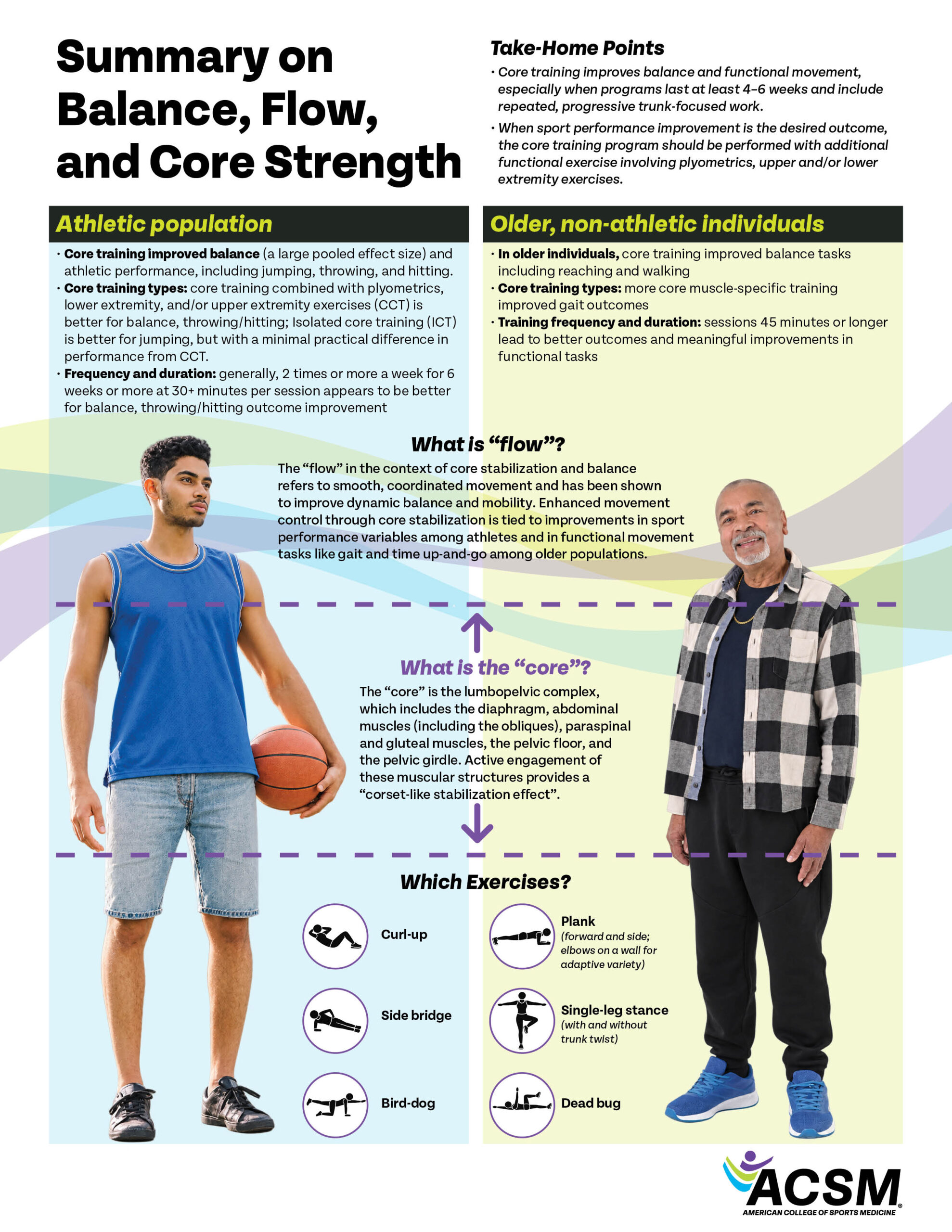
The “core” is another name for the lumbopelvic complex, with its muscular boundaries including the diaphragm, abdominal muscles (including the obliques), paraspinal and gluteal muscles, the pelvic floor, and the pelvic girdle. Active engagement of these muscular structures provides a “corset-like stabilization effect.” This core stabilization relies on pre-programmed, well-coordinated integration of multiple body functions, including the passive, active, and neural subsystems of the muscular structures in the “core” region. Core stabilization provides proximal stability, which leads to distal mobility and effective intersegmental force generation and transfer, contributing to performance enhancement and injury prevention (Kibler et al., 2006; Bliven et al., 2013).
What is “flow”?
“Flow” in the context of core stabilization and balance refers to smooth, coordinated movement and has been shown to improve dynamic balance and mobility. As outlined below, core stabilization training improves sports performance among athletes and functional movements among older individuals (Rodríguez-Perea et al., 2023; Zhong et al., 2025). Enhanced movement control through core stabilization is tied to improvements in sport performance variables among athletes and in functional movement tasks like gait and timed up-and-go among older populations.
Core Muscle Training Effectiveness
Athletic population
Meta-analysis by Rodríguez-Perea et al. (2023):
- Core training improved balance (a large pooled effect size) and athletic performance, including jumping, throwing, and hitting.
- Balance outcomes: effect size = 1.17.
- Throwing/hitting velocity: smaller effect, effect size = 0.30.
- Throwing/hitting distance: effect size = 3.42.
- Jumping: vertical jump effect size = 0.69; horizontal jump effect size = 0.84.
- Core training types include isolated core training (ICT, core training alone) and combined core training (CCT, core training combined with plyometrics, lower extremity, and/or upper extremity exercises).
- For balance and throwing/hitting outcomes, CCT is better.
- For jumping, ICT is better, but with a minimal practical difference in performance.
- For sport task improvements, training 2 or more times a week for 6 weeks or more, at 30+ minutes per session, generally appears to be better for balance and throwing/hitting outcomes.
Older, non-athletic individuals
Meta-analysis by Zhong et al. (2025):
- In older individuals, core training improved balance tasks.
- Greater improvements occurred with dynamic balance tasks, particularly functional reach, but gait and timed up-and-go performance also improved.
- Static balance tasks, including one-leg stance, also improved.
- These improvements suggest benefits for fall prevention and functional mobility.
- More core muscle-specific training improved gait outcomes (standardized mean difference, SMD = 0.66) compared to Pilates (SMD = 0.04).
- Sessions of 45 minutes or longer lead to better outcomes and meaningful improvements in functional tasks. For older individuals, longer sessions provide prolonged stimulation of the neuromuscular system and coordination.
Take-Home Points
- Core training improves balance and functional movement, especially when programs last at least 4–6 weeks and include repeated, progressive trunk-focused work.
- When sport performance improvement is the desired outcome, the core training program should include additional functional exercise involving plyometrics and upper and/or lower extremity exercises.
- When functional improvement among older individuals is the goal, core training should focus more on core musculature strengthening and coordination, rather than exercises like Pilates.
- Core stabilization can be achieved through progressive training to engage local muscle recruitment, core strength/stabilization exercises, and dynamic stability exercises.
Which Exercises?
Athletes: injury prevention and performance enhancement
- Core training should address deficiencies first (Kibler et al., 2006).
- “The big 3”: curl-up, side bridge, and bird-dog (Bliven et al., 2013).
Older adults: functional improvement and fall prevention
- Plank (forward and side; elbows on a wall for adaptive variety).
- Single-leg stance (with and without trunk twist).
- Dead bug.